
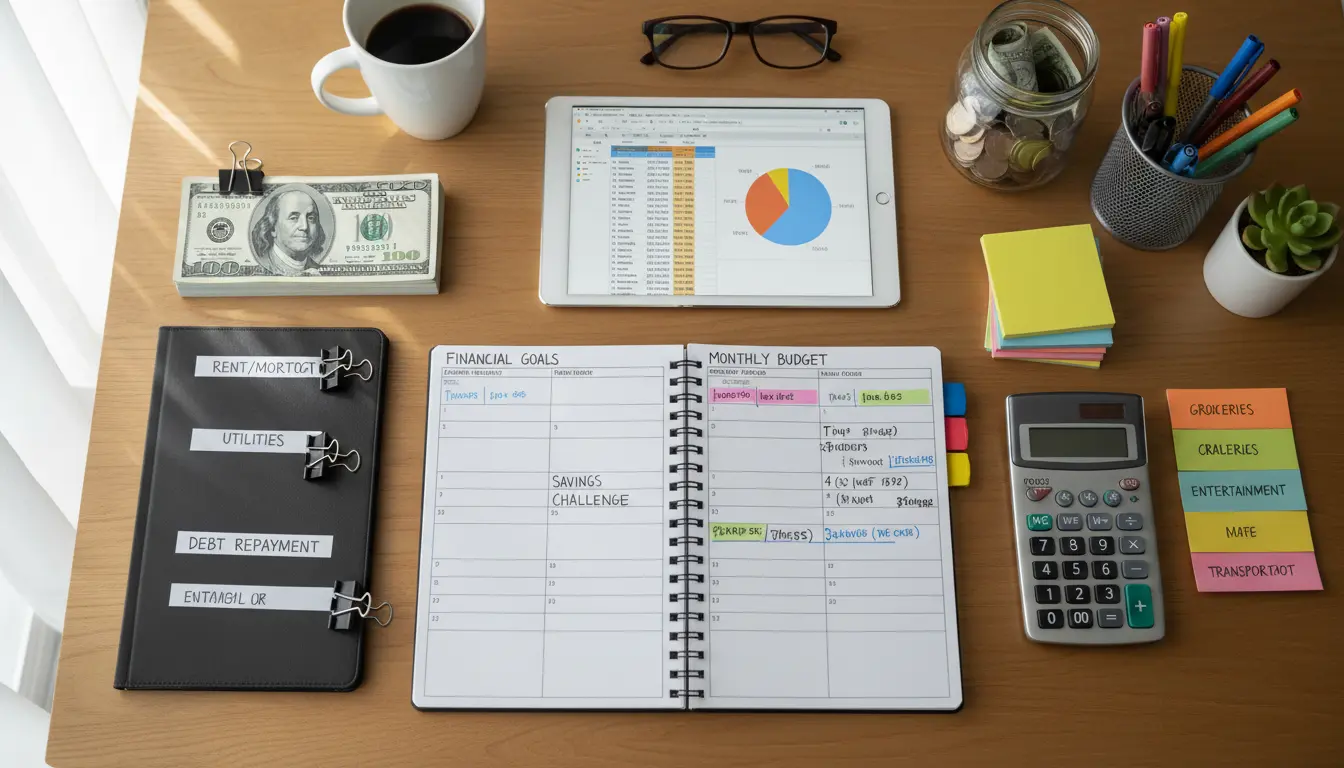
Why a Personal Budget Matters
A personal budget helps you control spending, reach financial goals, and prepare for emergencies. Without a clear plan, small expenses can derail long-term objectives.
Use a budget to decide priorities, reduce debt, and save for specific goals like a home, travel, or retirement. A working budget doesn027t have to be perfect; it needs to be practical and updated regularly.
How to Create a Personal Budget That Works
This section shows a simple, repeatable process to build a personal budget. Each step includes actions you can take today.
Step 1: Track Income and Expenses for Your Personal Budget
Start by listing all monthly income sources: salary, side gigs, investment income. Use net (after-tax) amounts for accuracy.
Track every expense for one month. Include fixed bills and variable purchases like groceries, transit, and subscriptions. Use bank statements, receipts, or a budgeting app.
Step 2: Categorize Spending
Group expenses into categories: Housing, Utilities, Food, Transport, Debt, Savings, Entertainment, and Miscellaneous. Keep categories consistent month to month.
Typical categories help spot where to cut back and where to maintain spending. Use broad categories at first, then refine if needed.
Step 3: Choose a Budgeting Method
Select a method that matches your goals and personality. Below are common, effective approaches.
- 50/30/20 Rule: 50% needs, 30% wants, 20% savings/debt. Good for simple allocation.
- Zero-Based Budgeting: Assign every dollar a job until income minus expenses equals zero. Best for tight finances or detailed planning.
- Envelope System: Use cash envelopes per category to limit spending. Helpful for impulse control.
Step 4: Build the Budget and Set Targets
Using your tracked numbers, allocate amounts to each category based on your chosen method. Be realistic; underestimating common costs creates friction.
Set clear, measurable targets: emergency fund goal, monthly debt payment, and savings percentage. Write them down or enter them into your app.
Step 5: Monitor and Adjust Your Personal Budget Monthly
Review at least once a month. Compare actual spending to planned amounts and adjust categories or habits as needed.
Expect to tweak the budget for seasonal expenses, income changes, or new goals. The budget should evolve, not be rigid.
Practical Tips to Keep a Personal Budget Working
- Automate savings and bill payments to reduce missed transfers and late fees.
- Limit subscription services by auditing them quarterly and cancelling unused plans.
- Use roundup savings features or transfer spare change to a savings account for small, passive progress.
- Set one or two short-term goals to stay motivated, like a small trip or a gadget purchase.
Tools and Examples for Personal Budgeting
Several tools make budgeting easier: spreadsheets, mobile apps (Mint, YNAB, EveryDollar), and simple paper planners. Pick one you will actually use.
Example methods applied:
- 50/30/20: Income $3,000 → $1,500 needs, $900 wants, $600 savings/debt.
- Zero-Based: Assign $3,000 across all categories so every dollar works toward a purpose.
People who track expenses weekly are more likely to stick to a budget. Small, regular reviews help catch problems before they grow.
Small Real-World Case Study
Case Study: Sarah, a 28-year-old graphic designer, earns $3,200 monthly net. Her fixed costs are $1,300 (rent, utilities, insurance). She tracked one month and found $700 in variable costs and $200 in subscriptions.
Sarah chose the 50/30/20 method to start. Allocation: $1,600 needs, $960 wants, $640 savings. She moved $300 to build an emergency fund and used $200 extra to accelerate student loan payments.
After two months she cut subscriptions by $50 and reallocated the savings to a travel fund. Regular tracking helped her identify a $120 monthly overspend on dining out and reduce it to $60.
Common Mistakes to Avoid When Creating a Personal Budget
- Setting unrealistic targets that are impossible to maintain long term.
- Ignoring irregular expenses like car maintenance or annual subscriptions.
- Failing to review the budget regularly and letting it become outdated.
Final Checklist to Start a Personal Budget Today
- Gather one month of income and spending records.
- Choose categories and a budgeting method.
- Set measurable short- and long-term goals.
- Automate savings and review monthly.
Creating a personal budget is a practical skill, not a one-time chore. Start simple, track consistently, and adjust as life changes. Over time, a working budget leads to clearer choices and better financial stability.