
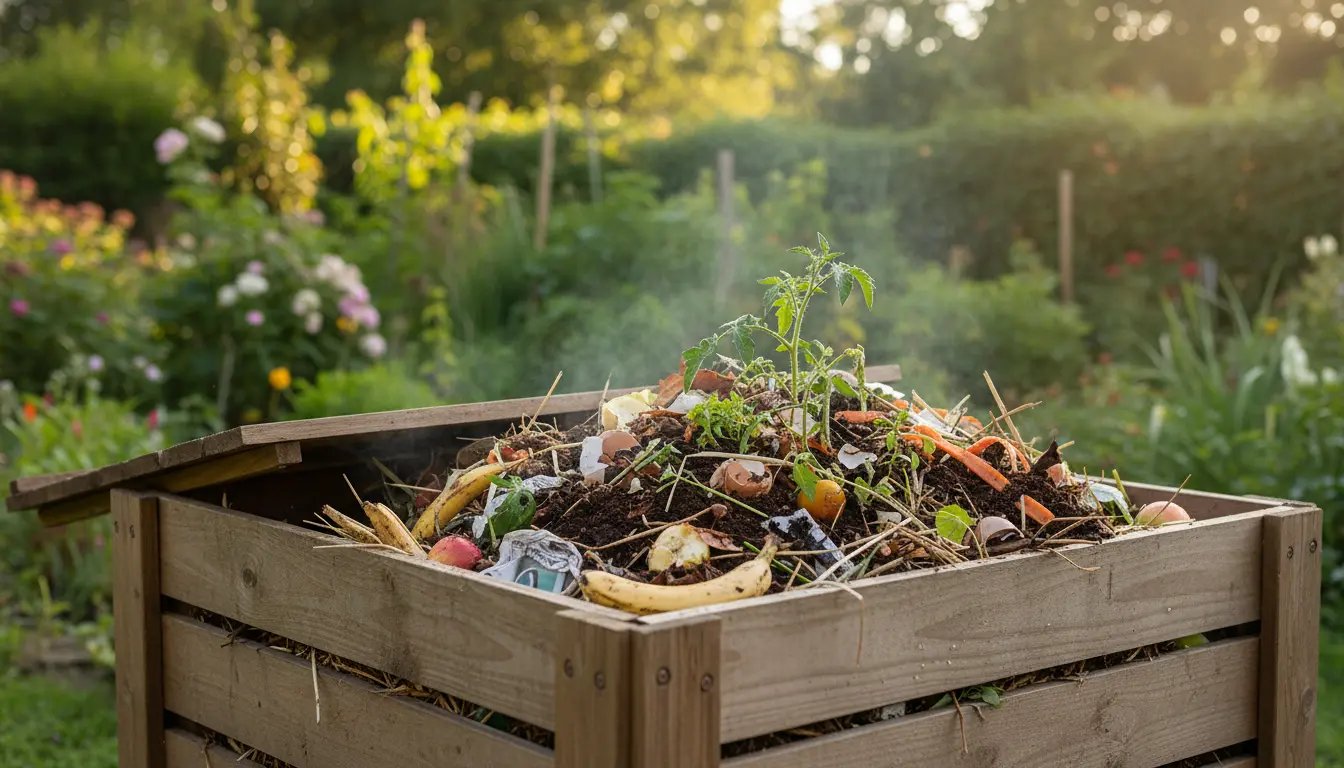
What is home composting?
Home composting is the controlled decomposition of organic household and yard waste into a nutrient-rich soil amendment. It transforms kitchen scraps, leaves, and grass clippings into compost that improves soil structure and plant health.
This process reduces landfill waste and recycles nutrients back into your garden. Home composting can be done in a bin, pile, tumbler, or vermicompost system depending on space and needs.
Why start home composting
Composting lowers household waste volume and provides free, healthy soil for plants. It also reduces greenhouse gas emissions associated with organic waste in landfills.
For many homeowners and renters, composting is a simple way to save money on fertilizer and improve lawn and garden performance.
How to start home composting
Starting is straightforward when you follow a few practical steps. Focus on container choice, materials, balance, and basic maintenance.
Choose the right bin for home composting
Select a bin that fits your space and composting goals. Options include stationary bins, tumblers, and open piles for larger yards.
- Backyard bin: Simple, inexpensive, and good for large volumes.
- Tumbler: Easier turning and faster decomposition, suitable for small yards.
- Vermicompost: Uses worms, ideal for indoor kitchens and apartments.
Materials to compost
Home composting relies on two material groups: greens and browns. Greens provide nitrogen, and browns supply carbon.
- Greens: Vegetable and fruit scraps, coffee grounds, fresh grass clippings.
- Browns: Dry leaves, shredded paper, cardboard, straw, wood chips.
Aim for a mix of roughly 2 to 3 parts browns to 1 part greens by volume to maintain a healthy balance.
Layering and aeration for home composting
Build layers by alternating browns and greens, and keep the pile moist like a wrung-out sponge. Aeration speeds decomposition and prevents odors.
- Turn or mix the pile every 1–2 weeks for hot composting.
- For tumblers, rotate every few days to a week.
- Vermicompost bins need minimal turning but do require occasional aeration and moisture checks.
Maintenance and timeline for home composting
Compost can be ready in a few months with active turning, or 6–12 months with slow, passive methods. Temperature, moisture, and particle size affect speed.
Check the pile weekly: it should be warm to the touch in the center and slightly damp. Add water if dry and more browns if soggy or smelly.
Troubleshooting home composting problems
Common issues are odors, pests, and a slow breakdown. Most problems are solved by adjusting moisture, balance, or aeration.
- Bad smell: Add more browns and turn the pile to add air.
- Pests: Use a closed bin, bury food scraps under a layer of browns, and avoid meat or dairy.
- Slow decomposition: Chop materials smaller, increase temperature with active turning, or add nitrogen-rich greens.
What not to put in a home composting pile
Avoid meat, dairy, oils, diseased plants, and pet waste. These items attract pests and can introduce pathogens to compost.
Using finished compost from home composting
Finished compost is dark, crumbly, and earthy-smelling. It can be used as a top dressing, soil amendment, or potting mix ingredient.
- Top dressing: Spread 1–2 inches around garden beds.
- Soil mix: Blend one part compost to three parts soil for planting.
- Lawn: Thinly spread compost and rake in for gradual improvement.
Small real-world case study
Case study: A small urban household in Portland started a 50-liter tumbler in spring. They collected kitchen scraps in a counter pail and emptied it into the tumbler twice a week.
Within four months of regular turning and a 3:1 brown-to-green ratio, they produced enough compost to renew two raised beds. Vegetable yields improved and grocery waste declined by nearly half.
Tips to keep home composting simple and effective
- Keep a small indoor container with a tight lid for daily scraps.
- Chop or shred larger items to speed breakdown.
- Record additions and turn dates to track progress.
- Use finished compost gradually and observe plant response.
Final checklist for successful home composting
- Choose a bin that fits your space and climate.
- Balance greens and browns roughly 1:2 to 1:3.
- Maintain moisture and aerate regularly.
- Avoid problematic items like meat and dairy.
- Use finished compost in garden beds and potting mixes.
Home composting is practical and scalable, from small apartment worm bins to large backyard systems. With basic routine and attention to balance, most households can produce rich compost that benefits plants and reduces waste.