

Remote Work Productivity: Start with a Clear Daily Structure
Remote work productivity begins with a predictable routine. A consistent start time, short pre-work ritual, and a defined end time tell your brain when to focus and when to rest.
Set three core work blocks each day: a morning deep-work block, a midday collaboration block, and an afternoon shallow-work block. These anchors help you match tasks to energy levels.
Remote Work Productivity: Define Your Work Blocks
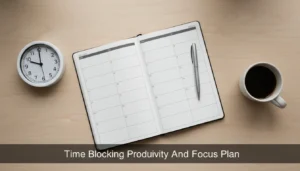
Use a calendar to block time for specific types of work. Treat those blocks as meetings with yourself to reduce context switching.
- Morning deep work: 60–90 minutes for high-focus tasks
- Midday collaboration: meetings, calls, and team updates
- Afternoon shallow work: email, admin, and low-focus tasks
Workspace Setup for Better Remote Work Productivity
A purposeful workspace reduces friction and boosts focus. You do not need a large room, but the area should be consistent and comfortable.
Prioritize ergonomics, lighting, and noise control to support sustained concentration.
- Desk and chair at proper heights to avoid strain
- Natural light or a daylight lamp for alertness
- Noise-cancelling headphones or white-noise for distractions
Examples of Small, High-Impact Changes

Often small adjustments create big gains in productivity. Swap a laptop stand for better posture, use a separate keyboard, or place a plant for reduced perceived stress.
Tools and Techniques That Improve Remote Work Productivity
Use simple tools to manage tasks, time, and communication. The goal is clarity, not complexity.
- Task manager (Todoist, Trello): keep a single source of truth for tasks
- Calendar app: block time and set meeting rules
- Time tracking (optional): assess where hours go over a week
- Focus timers (Pomodoro): 25–50 minute work sprints with short breaks
Communication Rules to Protect Focus
Agree on communication windows with teammates to avoid constant interruptions. Use async updates when possible and reserve real-time chat for urgent items.
- Status messages: set availability and expected response times
- Meeting hygiene: share agendas and desired outcomes ahead of time
- Reduce meeting frequency: combine updates into fewer sessions
Time Management Strategies for Remote Work Productivity

Choose a time management system and stick to it for at least two weeks to evaluate impact. Common systems include time blocking, the Eisenhower Matrix, and Pomodoro.
Prioritize tasks that move outcomes forward and defer or delegate low-value work.
Simple Prioritization Framework
Each morning, list your three highest-impact tasks for the day. Complete one during your first deep-work block to ensure progress on important work.
Handling Interruptions and Maintaining Focus
Interruptions are the biggest productivity drain for remote workers. Build barriers to protect focus and signal to others when you are in deep work.
- Visual cues: use a desk flag, headphones, or calendar status to indicate focus time
- Batch interruptions: check messages at set times instead of continuously
- Use short, scheduled breaks to reset attention
When You Need to Respond Immediately
Set clear escalation paths for urgent issues. For example, a specific Slack channel for critical items or a phone call only for emergencies.
Measuring and Improving Remote Work Productivity
Track a few simple metrics: completed tasks per week, hours in deep work, and number of uninterrupted focus sessions. Use these to spot trends and adjust routines.
Run a two-week experiment when you change one habit and compare results to the prior period.
Short breaks every 50–60 minutes can restore focus and reduce mental fatigue. A five-minute walk or stretch improves clarity for the next work block.
Small Case Study: Freelance Designer Improves Output
Maria, a freelance UX designer, struggled with inconsistent daily output while working from home. She implemented a morning deep-work block, set a strict no-meeting window, and used a simple Pomodoro timer.
Within eight weeks Maria increased billable project time by 20% and reduced late deliverables. Key changes were calendar blocks, a dedicated workspace, and a weekly review to prioritize tasks.
Practical Checklist to Boost Remote Work Productivity
- Set three daily work blocks and add them to your calendar
- Create a consistent workspace with ergonomic basics
- Agree communication windows with your team
- Use a simple task list and pick three priority tasks daily
- Run two-week experiments to test habit changes
Final Notes on Sustaining Remote Work Productivity
Consistency matters more than perfection. Small, repeatable habits compound into measurable gains over weeks.
Review your systems monthly and stay flexible as personal and team needs evolve. With clear structure and limited interruptions, remote work productivity will improve predictably.