
What is home composting?
Home composting turns kitchen scraps and yard waste into nutrient-rich soil amendment. It reduces landfill waste and helps gardens retain moisture and nutrients.
This guide gives a practical, step-by-step approach for people new to composting. Use the checks and examples to start a reliable system at home.
Why Home Composting for Beginners Makes Sense
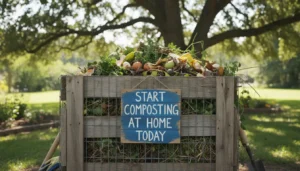
Composting is low cost and scalable to balconies, small yards, or larger gardens. Beginners can choose simple systems that require little maintenance.
Starting composting also cuts organic waste from trash and lowers methane emissions when waste avoids landfills.
Benefits of home composting
- Reduces household waste volume and disposal costs.
- Creates free, nutrient-rich compost for gardens and potted plants.
- Improves soil structure and water retention.
- Provides a hands-on way to learn about decomposition and ecology.
How to Start Home Composting for Beginners
Choose a method that fits your space and schedule. The common options are a simple pile, a closed bin, a rotating tumbler, or a worm bin for indoor composting.
Materials and tools you will need
- Compost container or designated pile (bin, tumbler, or worm bin).
- Kitchen scrap container with lid for daily collection.
- Garden fork or pitchfork for turning (not required for worm bins).
- Basic garden gloves and a moisture sprayer or watering can.
Choosing a composting method
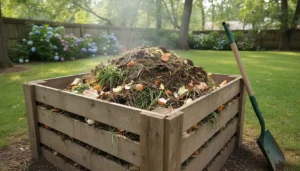
For small yards, a closed bin or tumbler controls pests and looks tidy. For apartments, vermicomposting (worm bin) works well indoors.
Beginners often prefer a stationary bin: it’s inexpensive and forgiving. Tumblers speed up decomposition and reduce turning effort.
Step-by-step composting process
Follow these practical steps to build and maintain a healthy compost pile.
- Pick a location: a level, partially shaded spot near a water source makes maintenance easier.
- Start with a base layer: coarse materials like twigs or straw improve airflow at the bottom.
- Add alternating layers: mix “greens” (nitrogen) and “browns” (carbon). Aim for roughly 2–3 parts browns to 1 part greens by volume.
- Maintain moisture: the pile should feel like a wrung-out sponge. Add water if dry, or more browns if soggy.
- Turn periodically: every 1–3 weeks to aerate the pile and speed decomposition. Tumblers reduce the need to fork-turn.
- Monitor temperature: a warm pile (120–160°F / 50–70°C) breaks down material quickly. Cold piles still compost more slowly.
- Harvest finished compost: when dark, crumbly, and earthy-smelling, the compost is ready to use—usually in 3–12 months depending on method and maintenance.
Examples of greens and browns
- Greens: fruit and vegetable scraps, coffee grounds, fresh grass clippings.
- Browns: dried leaves, shredded paper, straw, cardboard, small wood chips.
Common problems and solutions for home composting
New composters often face predictable issues. Address them with simple adjustments.
- Smell: Add more browns and turn the pile; smells indicate excess moisture or too many greens.
- Pests: Use a closed bin, bury food scraps under browns, and avoid meat, dairy, and oily foods.
- Slow breakdown: Increase surface area by chopping materials, add nitrogen-rich greens, and ensure adequate moisture and aeration.
- Soggy pile: Mix in dry browns and turn to add oxygen.
Composting one ton of food waste can offset the carbon dioxide equivalent of driving a car about 1,100 miles. Home composting makes a measurable climate impact when adopted widely.
Small real-world example
Case study: A family of four in a suburban backyard began a compost bin in spring. They used a 3-bin system and balanced greens and browns. After six months of turning every two weeks, they harvested about 0.4 cubic meters of rich compost.
They reported using the compost on vegetable beds and saving on soil amendments. Household food waste going to the trash dropped by roughly 30%.
Quick checklist for successful home composting
- Choose a method that fits space and effort level.
- Collect kitchen scraps daily in a covered container.
- Balance greens and browns and monitor moisture.
- Turn the pile regularly to add oxygen.
- Keep out meat, dairy, and oily foods to reduce pests.
- Be patient—compost improves over months and pays off in better soil.
Home composting for beginners is a practical way to reduce waste and enrich garden soil. Start with a small system, learn the basics of balance and moisture, and scale up once you see results.