
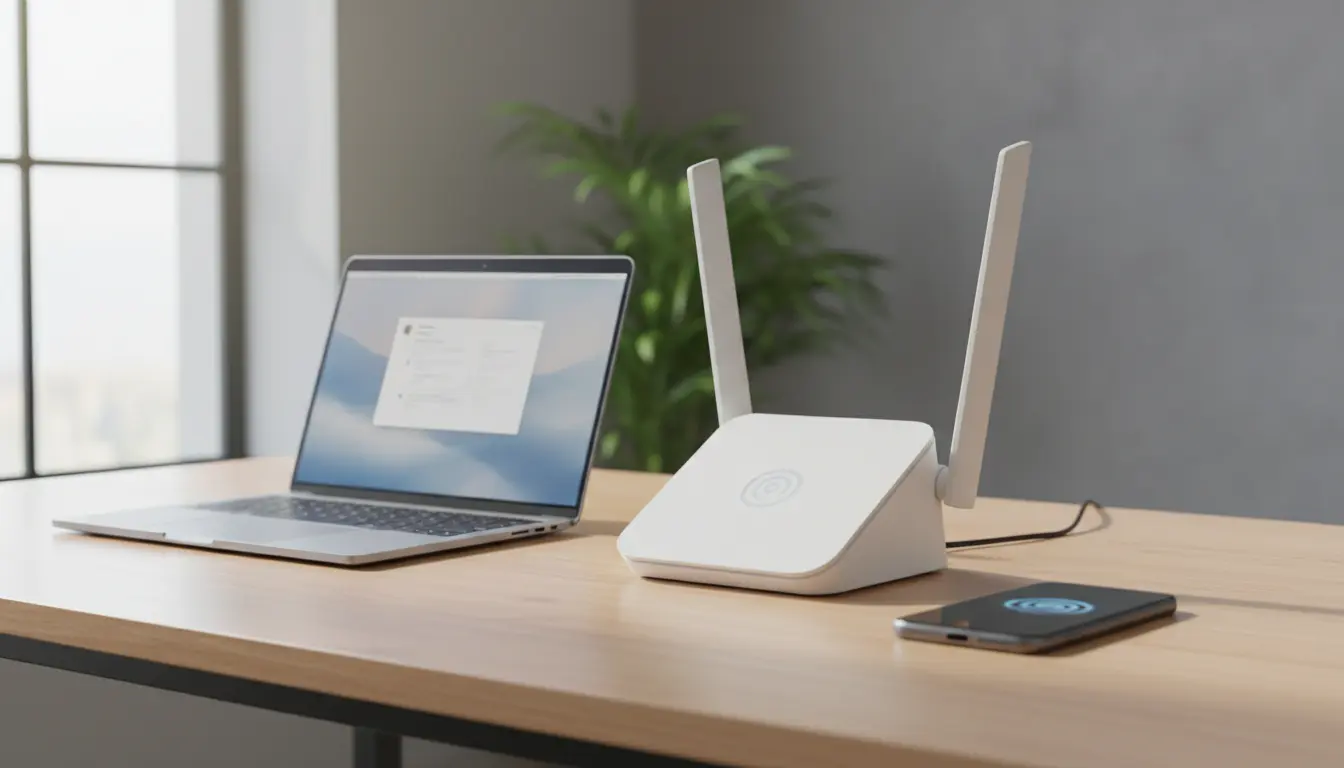
Understand your current home Wi-Fi speed
Start by measuring your baseline speed with a reliable speed test (use wired and wireless tests). Run tests at different times and in different rooms to see how the signal varies.
Record download, upload, and latency. These numbers help you decide whether the problem is your internet plan, the router, or interference inside your home.
Check both ISP speed and Wi-Fi speed
Test with an Ethernet cable to the modem or router to verify the service your ISP delivers. If wired speed is close to your plan but Wi-Fi is slow, the issue is local to your home network.
Quick fixes to boost home Wi-Fi speed
Begin with fast, low-effort steps that often solve common problems.
- Reboot your router: Power it off for 30 seconds and restart to clear temporary issues.
- Update firmware: Router manufacturers release fixes and performance improvements—install them.
- Reduce device load: Disconnect unused devices and pause large downloads or cloud backups during critical tasks.
- Restart devices: Sometimes the connected device, not the network, causes slowdowns—restart phones, laptops, and smart devices.
- Change location: Move the router away from walls, microwaves, cordless phones, and dense furniture.
Advanced steps to optimize home Wi-Fi speed
If quick fixes don’t help, try more technical adjustments that improve signal quality and throughput.
Choose the right channel and band
Use a Wi-Fi analyzer app to find less congested channels. For 2.4 GHz, pick channel 1, 6, or 11 with the least overlap. For 5 GHz, select a clear channel—there are more non-overlapping options.
Switch between 2.4 GHz (better range) and 5 GHz (higher speeds, shorter range) as needed. Many modern routers support automatic band steering; test if this helps.
Adjust wireless mode and settings
Set your router to use modern Wi-Fi standards like 802.11ac or 802.11ax (Wi‑Fi 5 or Wi‑Fi 6) if all devices support them. Avoid forcing mixed legacy modes unless needed for old devices.
Disable legacy features like WPS if you don’t use them, and ensure encryption uses WPA2 or WPA3 for security without harming performance.
Placement and hardware choices to improve home Wi-Fi speed
Sometimes physical upgrades or relocation deliver the biggest gains.
- Centralize the router: Place it near the center of your home and elevated on a shelf rather than hidden in a cabinet.
- Use quality antennas or a mesh system: Replace weak antennas or switch to a mesh Wi‑Fi system for large homes or multiple floors.
- Consider wired backhaul: For mesh systems, use Ethernet backhaul between nodes for consistent high speed.
- Upgrade older equipment: Routers over five years old often lack performance features found in newer models.
Use extenders and access points correctly
Wi‑Fi extenders can help but may halve throughput if using wireless backhaul. Prefer wired access points or mesh nodes with wired backhaul for best results.
Monitor and maintain your home Wi-Fi speed
Regular checks and small changes keep a network healthy over time.
- Schedule monthly speed tests and keep a log of results.
- Apply firmware updates and review connected devices periodically.
- Set QoS (Quality of Service) rules if your router supports them to prioritize video calls or gaming.
Many homes lose more than 50% of their advertised internet speed on Wi‑Fi due to placement, interference, and old routers. Simply moving a router just a few feet or changing channels can often restore much of that performance.
Small real-world case study
Case: A family of four complained of slow streaming and laggy video calls in the upstairs bedrooms. Their ISP speed was adequate when tested by cable.
Actions taken: The router, hidden in a living room cabinet, was moved to a central shelf, firmware updated, and the 5 GHz band prioritized for video calls. An inexpensive mesh node was added with wired backhaul for the upstairs.
Result: Measured upstairs download speeds rose from 12 Mbps to 75 Mbps. Video call stability improved immediately and streaming interruptions stopped during peak hours.
Checklist to boost home Wi-Fi speed
- Measure wired and wireless speeds to find where the bottleneck is.
- Reboot router and update firmware.
- Improve router placement and remove nearby interference.
- Choose optimal channels and correct band (2.4 vs 5 GHz).
- Consider hardware upgrades: antennas, mesh, or a new router.
- Monitor speeds monthly and use QoS for mission-critical apps.
Follow these steps systematically, starting with tests and simple fixes, then moving to configuration changes and hardware upgrades. You can often achieve a noticeable improvement in home Wi‑Fi speed with a few targeted changes.