
Working from home or a remote location requires deliberate systems to maintain focus and output. This guide gives clear, actionable steps for improving remote work productivity without jargon.
Remote Work Productivity Basics
Start by identifying measurable goals for your workday. Clear goals reduce decision fatigue and help you prioritize tasks with the biggest impact.

Use simple metrics like completed tasks, focused hours, or progress on a weekly project to track improvements.
Workspace Setup for Remote Work Productivity
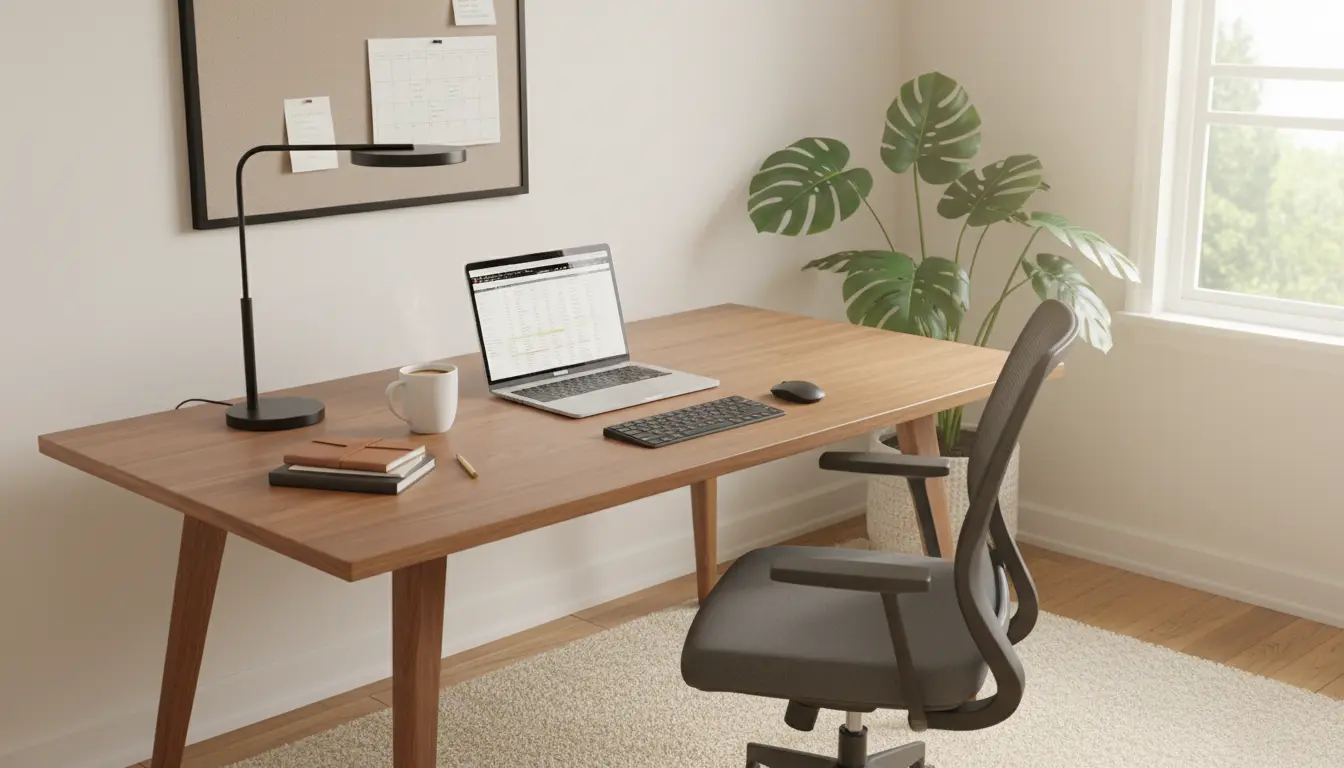
Your physical environment shapes attention and comfort. Dedicate a defined area for work, even if it is a corner of a room.
Key elements to include are an ergonomic chair, stable surface for your laptop, and controlled lighting to reduce eye strain.
- Minimize visual clutter with a simple shelf or storage box.
- Keep essential items within arm’s reach: charger, notebook, headset.
- Use natural light when possible and add task lighting for late hours.
Daily Routines and Time Blocking for Remote Work Productivity
Structure beats motivation. Set a predictable start time, short breaks, and an end-of-day routine to close tasks and plan tomorrow.
Time blocking divides your day into themed periods for focused work, meetings, and admin tasks. Try blocks of 60–90 minutes for deep work.
- Morning: 90 minutes of the highest-priority task.
- Midday: Meetings and collaborative work only within a fixed window.
- Afternoon: 60-minute block for routine tasks and follow-ups.
Tools to Improve Remote Work Productivity
The right tools reduce friction between intention and action. Choose one tool per problem to avoid tool overload.
Communication and Collaboration Tools for Remote Work Productivity
Limit synchronous communication to scheduled times. Use chat apps for quick updates and video calls for complex discussions.
- Set ‘office hours’ for instant messaging to protect deep work time.
- Use shared documents for asynchronous collaboration and version control.
Task and Time Management Tools for Remote Work Productivity
Task managers and timers help convert plans into measurable progress. Pick a simple task list and a Pomodoro or time-blocking app.
Common patterns include a single master task list, daily top-3 priorities, and short focus sprints using a timer.
Habits and Best Practices for Remote Work Productivity
Repeatable habits create reliable outcomes. Focus on small habit changes that compound over weeks.
Examples include planning a five-minute agenda before every meeting and ending each day by listing three tasks for tomorrow.
Prevent Burnout and Maintain Focus
Remote work can blur boundaries between personal and work life. Protect recovery time to sustain long-term productivity.
- Schedule non-negotiable breaks and a strict stop time for the day.
- Take short walks or physical activity between blocks to reset focus.
- Use a ‘do not disturb’ mode during deep work periods.
Research has shown remote employees can be more productive when given a stable environment and clear goals. One study measured a notable increase in output among remote workers who used structured schedules and dedicated workspaces.
Small Real-World Case Study
Case: A freelance marketing consultant reorganized her day to follow time blocking and removed open chat notifications during deep work. She tracked billable hours and client deliverables for eight weeks.
Results: Billable output rose by about 20% and stress levels dropped. The consultant attributed the improvement to a clearer work routine and fewer context switches.
Practical Quick-Start Checklist for Remote Work Productivity
Use this checklist to implement changes in one week. Focus on one habit change at a time to avoid overwhelm.
- Designate a dedicated work spot and clear clutter.
- Set a consistent start and end time for each workday.
- Create a daily top-3 priority list every morning.
- Block two deep-work sessions of 60–90 minutes each.
- Turn off non-essential notifications during focus blocks.
- Review weekly progress and adjust blocks the following week.
Final Steps to Improve Remote Work Productivity
Begin with one or two changes from the checklist and measure the effect for two weeks. Small adjustments, consistently applied, yield the biggest gains.
Track results with simple metrics and refine the system to match your work rhythm. Over time, these practices build a reliable and productive remote work routine.