
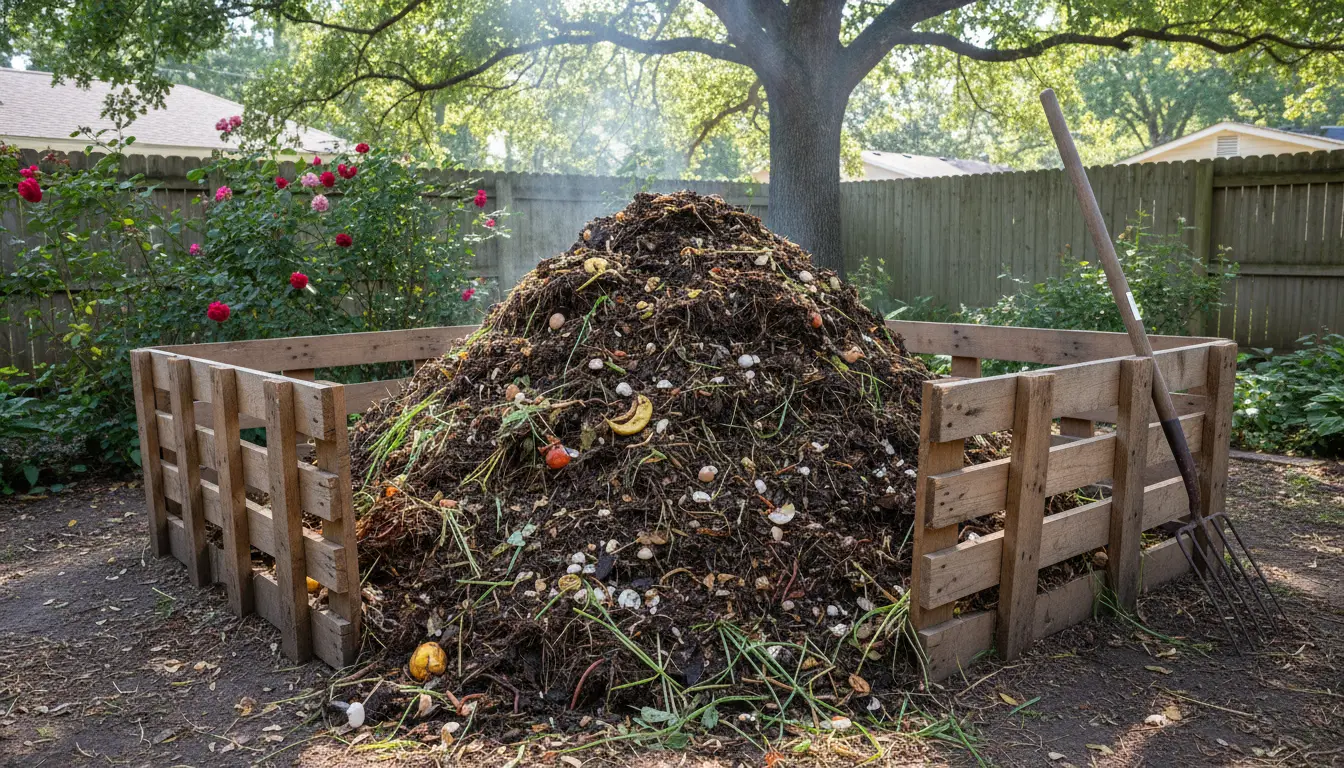
Why Home Composting Matters
Home composting reduces household waste and returns nutrients to soil. It lowers garbage volume and supports healthier plants without synthetic fertilizers.
This guide explains simple, practical steps to start and maintain a home composting system. The instructions focus on common materials and routine care.
Home Composting Basics
Compost forms when organic materials break down through microbial activity. Key ingredients are carbon rich ‘browns’ and nitrogen rich ‘greens’.
Balance, moisture, and airflow are the main factors that determine speed and quality of compost.
Essential Materials for Home Composting
- Greens: kitchen scraps, fresh grass clippings, coffee grounds.
- Browns: dried leaves, shredded paper, straw, cardboard.
- Water: keep pile damp like a wrung-out sponge.
- Oxygen: occasional turning or a ventilated bin.
Setting Up Home Composting
Choose a container: a tumbler, plastic bin, or a simple open pile works. Consider space, neighborhood rules, and pest control when selecting a method.
Location matters. Place the bin on soil if possible to allow worms and microbes to enter. Choose partial shade to avoid drying out.
Step-by-Step Setup
- Start with a 4–6 inch layer of coarse brown material for drainage and airflow.
- Add alternating layers of greens and browns, keeping roughly a 1:2 ratio by volume (greens to browns).
- Sprinkle water lightly after each few additions to maintain moisture.
- Cover the top with a brown layer or a lid to reduce odors and pests.
Maintaining Your Home Composting System
Regular maintenance ensures efficient decomposition and prevents problems. Check the pile weekly for moisture, odor, and temperature.
Turn the pile every 1–3 weeks to introduce oxygen. Tumble or use a pitchfork for garden piles.
Temperature and Time
Active compost heats between 110°F and 160°F when decomposition is rapid. Home piles may be cooler but still break down effectively.
Compost can be ready in 2–6 months depending on materials, particle size, and maintenance. Finished compost smells earthy and is dark and crumbly.
Troubleshooting Home Composting
Common issues are odors, pests, and slow decomposition. Each problem has a simple fix.
Odor Problems
- Cause: Too many greens or anaerobic conditions.
- Fix: Add more browns, increase turning, and check moisture.
Pest Problems
- Cause: Food scraps left exposed or meat and dairy added.
- Fix: Bury scraps deeper, use a closed bin, or avoid attracting animals with a secure lid.
Slow Decomposition
- Cause: Pile too dry, too compact, or lacking nitrogen.
- Fix: Moisten the pile, chop materials smaller, and add fresh greens or a nitrogen source like grass clippings.
Use Cases and Practical Tips for Home Composting
Use finished compost as a soil amendment, mulch, or potting mix component. It improves soil structure and water retention.
For small spaces, try a worm bin (vermicompost) which excels at breaking down kitchen scraps and produces concentrated, nutrient-rich castings.
Quick Practical Tips
- Chop or shred large materials to speed breakdown.
- Keep a kitchen scrap bucket with a tight lid to collect greens easily.
- Rotate batches so one section can finish while you build another.
Real-World Example: Case Study
Case study: A small household of three started a 3-bin backyard compost system. They followed a 1:2 greens-to-browns rule and turned the middle bin weekly.
After four months they produced about 30 liters of finished compost. They used it in vegetable beds and saw improved tomato growth and reduced need for store-bought fertilizer.
Final Checklist for Starting Home Composting
- Choose a bin type suited to your space and local rules.
- Collect kitchen scraps and brown materials separately.
- Maintain moisture and aeration; turn regularly.
- Troubleshoot odors and pests quickly by adjusting balance or covering scraps.
- Harvest finished compost and apply it to soil or containers.
Home composting is a simple, cost-effective way to manage organic waste and improve garden health. With basic setup and routine care, almost any household can convert kitchen and yard waste into valuable compost.